
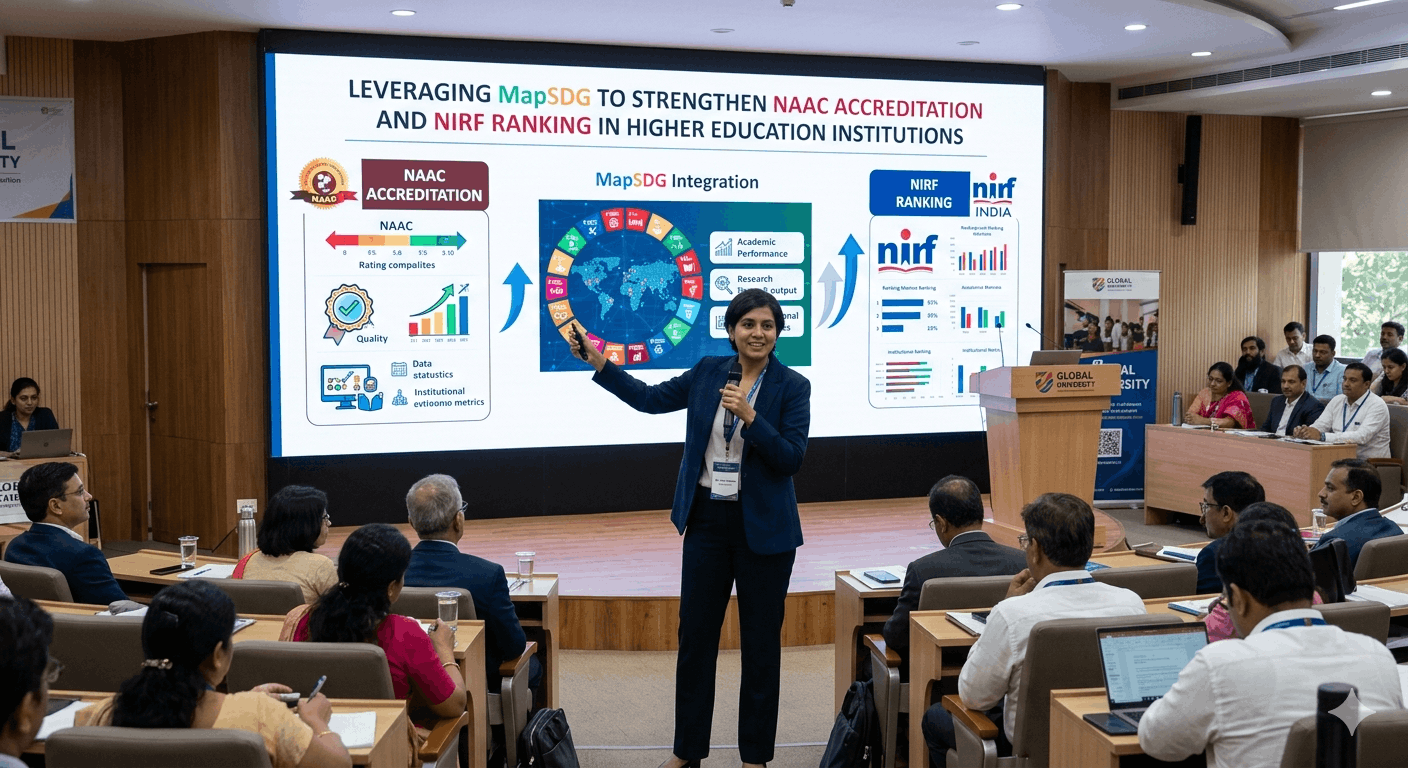
Higher Education Institutions (HEIs) in India operate within a dual quality ecosystem shaped by accreditation and ranking frameworks—namely the National Assessment and Accreditation Council (NAAC) and the National Institutional Ranking Framework (NIRF). While NAAC focuses on qualitative institutional assessment through a structured peer-review process, NIRF evaluates institutions quantitatively based on measurable performance indicators.
In this evolving landscape, platforms like MapSDG offer a transformative approach by integrating Sustainable Development Goals (SDGs) into institutional strategy, data systems, and impact measurement. This alignment provides a powerful bridge for HEIs to simultaneously address NAAC accreditation requirements and improve NIRF rankings.
Understanding NAAC and NIRF Requirements
NAAC evaluates institutions based on seven key criteria, including curricular aspects, teaching-learning processes, research, infrastructure, governance, and institutional values. These criteria emphasize holistic quality, continuous improvement, and documentation through mechanisms such as Annual Quality Assurance Reports (AQAR).
On the other hand, NIRF ranks institutions annually using five major parameters:
- Teaching, Learning & Resources (TLR)
- Research and Professional Practice (RPC)
- Graduation Outcomes (GO)
- Outreach and Inclusivity (OI)
- Perception (PR)
While NAAC assesses “how well” an institution functions, NIRF evaluates “how much” it performs relative to others. Both frameworks, however, converge on themes such as quality education, research impact, inclusivity, and societal engagement.
MapSDG: A Strategic Enabler
MapSDG is uniquely positioned to act as a digital backbone for HEIs by embedding SDGs into institutional operations. Its relevance lies in three core capabilities:
- Real-time Data Capture and Dashboards
- Outcome-based SDG Mapping of Activities
- Impact Measurement and Reporting
These capabilities directly align with the expectations of both NAAC and NIRF.
1. Supporting NAAC through Structured Data and Documentation
NAAC places strong emphasis on evidence-based assessment and continuous quality improvement. MapSDG enables HEIs to systematically capture institutional activities—academic, research, outreach, and administrative—and map them to SDG indicators.
Criterion I & II (Curricular and Teaching-Learning):
MapSDG allows institutions to map curriculum components to SDGs, demonstrating relevance, interdisciplinarity, and outcome-based education.
Criterion III (Research, Innovations, and Extension):
By tagging research projects, publications, and extension activities to SDGs, institutions can showcase societal impact—a key NAAC requirement.
Criterion VI (Governance and Leadership):
The platform’s dashboards provide leadership with real-time insights, enabling data-driven decision-making and transparent governance.
Criterion VII (Institutional Values and Best Practices):
Sustainability initiatives, gender equity programs, and environmental practices can be systematically recorded and reported through SDG alignment.
Thus, MapSDG reduces the burden of manual documentation and strengthens AQAR and SSR submissions with credible, structured data.
2. Enhancing NIRF Performance through Quantifiable Metrics
NIRF’s quantitative framework demands accurate, verifiable data across multiple parameters. MapSDG helps institutions track and improve these metrics:
Teaching, Learning & Resources (TLR):
SDG-integrated pedagogy, student engagement, and experiential learning can be measured and demonstrated through platform analytics.
Research and Professional Practice (RPC):
Research mapped to global challenges (SDGs) enhances visibility and relevance, improving research output quality and citations.
Graduation Outcomes (GO):
Skill development programs aligned with SDGs (e.g., climate action, innovation, social entrepreneurship) improve employability and higher education progression.
Outreach and Inclusivity (OI):
Community engagement, rural outreach, and inclusivity initiatives—core to SDGs—can be tracked and quantified, directly boosting this parameter.
Perception (PR):
Institutions demonstrating measurable SDG impact build stronger reputation among stakeholders, positively influencing perception scores.
By converting qualitative activities into measurable indicators, MapSDG strengthens the data backbone required for NIRF submissions.
3. Bridging NAAC and NIRF through SDG Integration
One of the biggest challenges for HEIs is the fragmentation between accreditation and ranking processes. MapSDG acts as a unifying framework:
Common Data Repository:
A single platform eliminates duplication of efforts across NAAC and NIRF reporting.
Standardized Metrics:
SDG indicators provide globally accepted benchmarks that align with both frameworks.
Continuous Monitoring:
Unlike static reporting cycles, MapSDG enables real-time tracking, ensuring institutions remain “always ready” for both accreditation and ranking.
Evidence of Impact:
Both NAAC and NIRF increasingly value societal impact—MapSDG quantifies this in a structured manner.
4. Driving Institutional Transformation
Beyond compliance, MapSDG fosters a shift from input-based education to outcome-based and impact-driven education:
- Encourages interdisciplinary learning linked to real-world problems
- Promotes student participation in sustainability projects
- Aligns institutional strategy with global priorities (SDGs)
- Builds a culture of accountability and continuous improvement
This transformation is critical as higher education moves toward global benchmarking and sustainability-focused evaluation systems.
Conclusion
In the current higher education ecosystem, excelling in NAAC accreditation and NIRF ranking requires more than compliance—it demands integrated, data-driven, and impact-oriented institutional practices. MapSDG provides a comprehensive solution by embedding SDGs into the core functioning of HEIs, enabling them to generate credible data, demonstrate societal relevance, and continuously improve performance.
By aligning institutional activities with SDGs and translating them into measurable outcomes, MapSDG not only simplifies NAAC and NIRF processes but also positions institutions as leaders in sustainable and responsible education. In doing so, it transforms compliance into a strategic advantage—bridging quality assurance with global impact.
